
Catmint (Nepeta)
Plant Spotlight
A Long-Blooming, Deer-Resistant Perennial
I remember first noticing this plant while driving past the beautifully landscaped homes along the river near where we live.
In the summertime, they seemed to appear everywhere, spilling out of garden beds alongside panicle hydrangeas and ornamental grasses.
I had never really seen it growing in the city, but here it seemed surprisingly popular. Catmint (Nepeta) is a long-blooming, drought-tolerant perennial for full sun, valued for its extended bloom period and strong resistance to deer and rabbits. It flowers from late spring through summer and often reblooms into fall with a light shearing.
These pale-purple, lavender-like plants form soft clouds along the edges of garden beds, creating beautiful mounding structure and adding a touch of whimsical movement to the landscape.
Eventually, I spotted one at a local nursery and asked the salesperson what it was.
She told me it was a classic variety of Catmint (Nepeta) called ‘Walker’s Low.’
Over the years I’ve picked up several varieties, including Proven Winners’ ‘Cat’s Pajamas’, an early blooming compact variety (about 12" tall and 12–18" wide), ‘Cat’s Meow’, which grows slightly larger (about 24" tall and wide), and ‘Six Hills Giant,’ a larger variety that can reach roughly 24”–36” tall and wide.
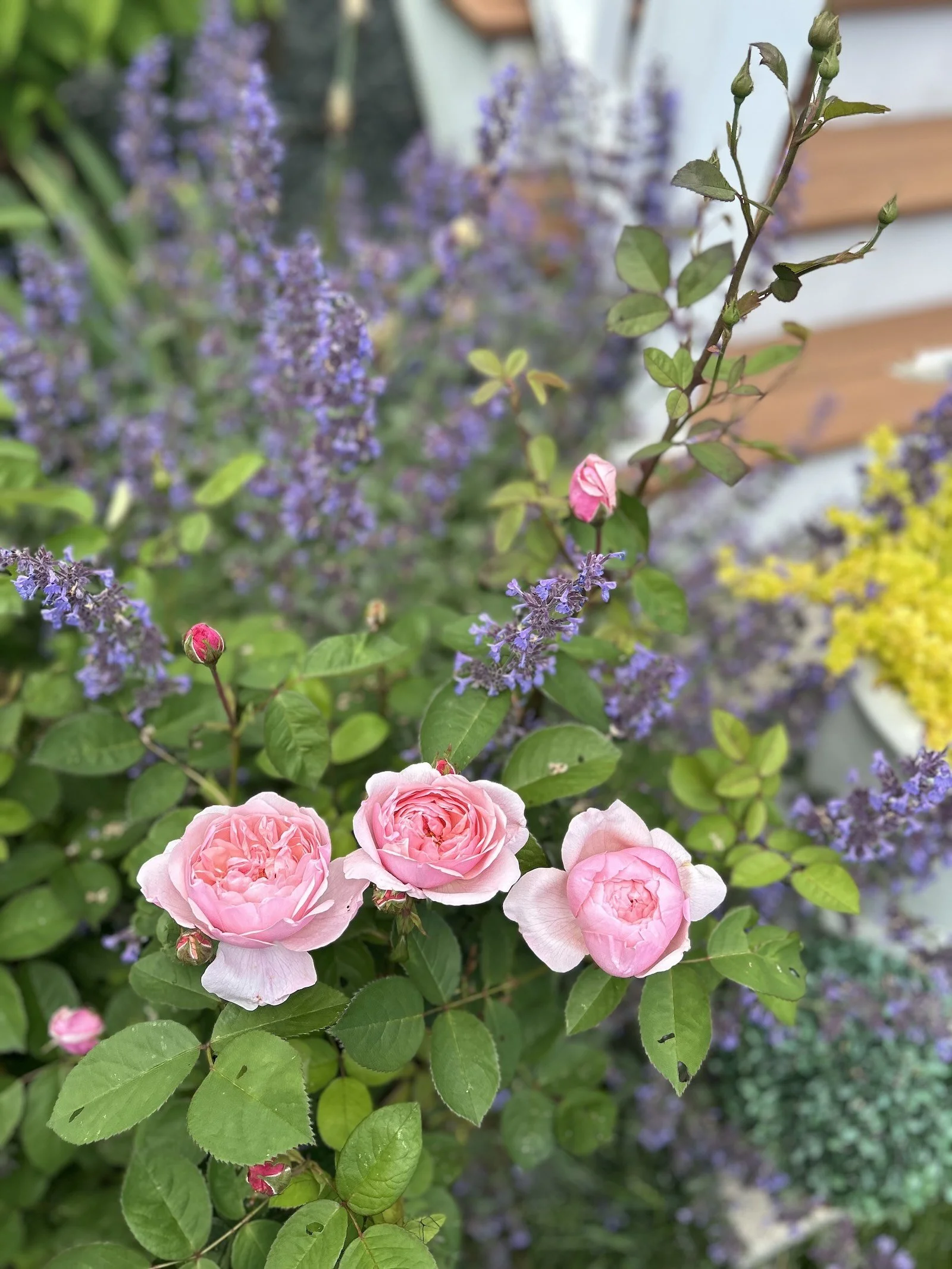
In my garden, Nepeta ‘Walker’s Low’ (Nepeta faassenii) camouflages the legs of my David Austin ‘Alnwick’ roses. Photo by Parsley & Petal.
Catmint at a Glance
(In My Garden)
Botanical name
Nepeta
Common name
Catmint
USDA Zones
3-9
Bloom time
Late spring through summer (often reblooming into fall in the Northeast)
Light
Full sun
Deer resistance
High
Rabbit resistance
High
Size
12"–36" depending on variety
Shape
Soft mounding perennial
Garden role
Ideal for sunny, drought-tolerant gardens where deer and rabbits are a concern. Adds long seasonal interest and airy movement to the garden.
In My Garden
What I love most, besides the unusual grey-green foliage and soft scent, is that catmint seems to flower endlessly.
In my garden, it begins flowering in late spring, usually around the end of May or early June, and will continue to rebloom into the fall if cut back again.
When the plants are at their peak, they are absolutely buzzing with bees. I often see both honeybees and the rounder bumblebees moving from flower to flower throughout the day.
After the first flush of flowers fades, I shear the plants back — a process called deadheading — and within two or three weeks they produce a fresh round.
Catmint is wonderfully easygoing and low-maintenance. It tolerates a wide range of soil conditions in my yard, as long as it is well-draining.
The only pest issue I’ve occasionally encountered is spider mites on ‘Cat’s Pajamas.’ When that happens, I spray them off with a strong blast of water (or use Neem oil for stubborn infestations), and it quickly recovers.
Catmint is not invasive in my garden—it stays where I put it—but it is easy to propagate from cuttings, so I plant them in drifts, usually in groups of three or five, to repeat the texture and color throughout the garden. Designing the garden this way helps the landscape feel more cohesive and calming to the eye.
I often pair it with the warm yellow-orange tones of black-eyed Susans, and I’ve also used it to soften the legs of my David Austin ‘Alnwick’ and ‘Queen Elizabeth’ roses.
In the front garden, I have a cluster of the smaller varieties scattered along landscape boulders among ‘Autumn Joy’ sedum, ‘Stella d’Oro’ daylilies, and Geranium macrorrhizum.
Another grouping of ‘Cat’s Pajamas’ surrounds my Rosa ‘The Fairy’ polyantha rose bush.
Wherever it’s planted, catmint seems to bring a lightness to the garden, a soft wash of color that sways gently in the wind.
Continue ReadingJoin Parsley & Petal